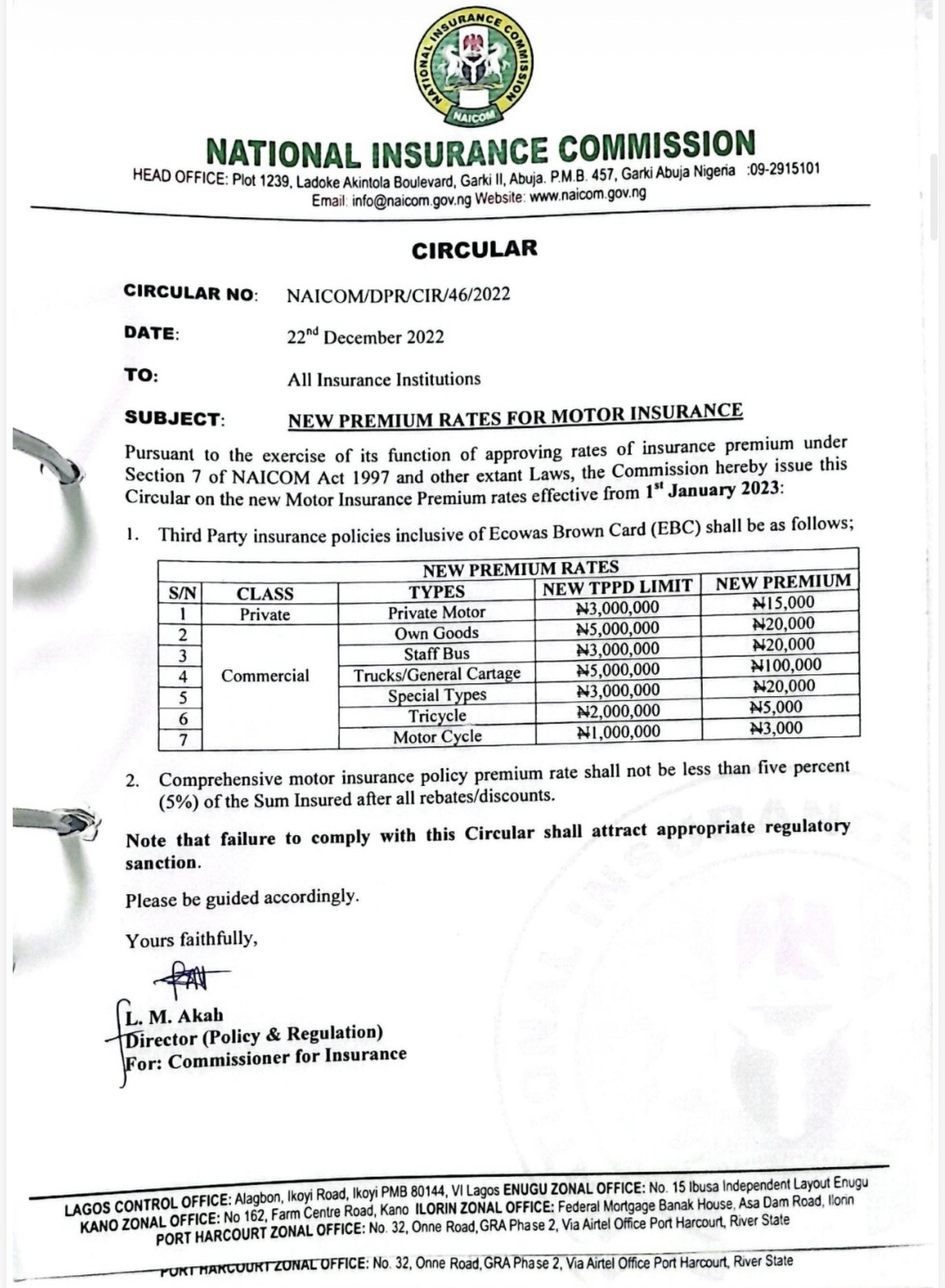
A business that runs vehicles, whether one delivery bike or a small fleet, needs to know these rates. NAICOM sets them, and insurers cannot charge above them.
Why third-party cover is compulsory
Every vehicle on Nigerian roads needs at least third-party insurance, covering damage the vehicle causes to someone else's property. It is not a business choice. It is a legal minimum.
For a company running any vehicle, from a courier bike to a delivery truck, this is the baseline cost of putting that vehicle on the road at all.
Rates by vehicle type
NAICOM fixes the premium by vehicle type, not by insurer.
| Vehicle type | Third-party premium |
|---|---|
| Motorcycle | ₦3,000 |
| Tricycle | ₦5,000 |
| Private car | ₦15,000 |
| Commercial vehicle | ₦20,000 |
A business running several vehicle types pays the matching rate for each one, not a blended average across the fleet. A courier firm with bikes and a single delivery van, for example, pays the bike rate for each bike and the van's own rate separately.
What the private car rate includes
The private car premium of ₦15,000 covers third-party property damage up to ₦3,000,000. It also includes the ECOWAS Brown Card, useful if the vehicle ever crosses a land border.
A commercial vehicle has its own damage limits too, set out in NAICOM's circular and not repeated here. The premium varies as well: trucks and general cartage vehicles pay a higher rate than other commercial vehicles. Ask your insurer for the exact figures for your vehicle.
Why enforcement has stepped up
NAICOM told insurers to hold to these rates as the police and FRSC began nationwide enforcement of compulsory third-party cover. For a business, that means a vehicle without valid cover is a real operational risk, not a paperwork technicality.
Keep proof of cover in every vehicle, not just on file at the office.
Where these rates come from
These figures come from NAICOM's own circular setting motor insurance rates, effective from 1 January 2023 and confirmed again in a 2025 circular as enforcement increased. No newer rate circular had replaced them as this was written.
For the fuller cover a business vehicle may also need, see comprehensive insurance for a company vehicle.
Common mistakes
- Assuming one rate covers every vehicle type. A motorcycle, a car and a truck each carry a different fixed premium.
- Treating third-party cover as covering your own vehicle too. It only covers damage to someone else's property.
- Accepting a quote below the set rate. A premium under NAICOM's figure is a warning sign, not a bargain.
- Letting cover lapse between renewals. Enforcement has increased, and a gap in cover is easy for police or FRSC checks to catch.
For other government charges a small business budgets for, see the government fees tool. The rest of this series is on the SME regulators hub.